You Could Try One
How We Learn
Swim
Bike
Run
Open Water Swims
Warmup/Cooldown
Wetsuits
Tech Wear & Tri Suits
Rules
Stretching
Strength Training
Nutrition Basics
Losing Weight
Nutrition For Athletes
Race Nutrition
Race Lengths
Training, Tapering
Cramps
Creaky Knees
Gadgets
Running Shoes
Gear Checklist
Race Day
Picks & Pans
Warning Label
Marathon (the song)
Also Try Feldenkrais
Running Shoes
There once was a kingdom with a very artistic and clever citizenry. Realizing that the human foot was ugly in its shape and that it would look oh so much more charming if it were smaller, they devised of a method of tightly wrapping the foot in cloth as a child grew up. By doing so they prevented the foot from growing into its normal grotesque dimensions. The only problem is that the small stubs of feet that resulted were not terribly useful for walking. So it really wasn't a smart approach for men or even women who had to accomplish anything. But a woman of the aristocracy could be carried about in chairs, in which case not being adept at walking would not be a serious problem. The peasant women were doomed to their labor and the shame of big awful loathsome feet.
This, of course, was Chinese foot-binding. And looking back from our more evolved perspective it seems utterly bizarre. We know that feet don't need to be small to be attractive. They should be pointed.

We actually fought this battle 40 years ago, and in most areas of life we've won it. These days you have a numerous options of shoes shaped like the human foot. There are three glaring exceptions: the shoes women wear to cocktail parties, bike shoes, and running shoes. Take a look at the shoes above. Does the human foot round inward in the way the running shoe in the middle does? The design people at the running shoe companies all seem to think the shoes must look symmetrical or we won't buy them. Notice that the shoe on the right has the boxier look of a human foot. If you'll take one of your shoes off and look at your bare foot, you'll realize it looks nothing like the shoes you're offered in your average running store.
The Shoe Industry Paradigm
If you go into a quality athletic shoe store some clerk will probably look at your foot and based on a couple of simple evaluations (like the height of your arch or the degree of pronation) tell you that you should get a "motion-control" or "stability" or "neutral-cushioned" or "performance-training" shoe. That's the theory that's taken hold in the shoe industry. The right shoe for the right foot will avoid injuries. I have been unable to find any scientific support for this premise. In fact the Marines, the Army and the Air Force have studied this. They all expect their recruits to do a lot of running in basic training and injuries really get in the way. So getting this right matters to them. They split their studies into two groups. In one group everyone got a stability shoe. In the other group each soldier got a shoe selected based on the criteria mentioned above. And they found absolutely no difference in the injury rate between the two groups. The whole premise is flawed.
There's a new shoe company trying to make its mark called Altra. (I've got a pair and love them. More on Altra below.) They were kind enough to send me a photo showing the different approaches. Take a look.
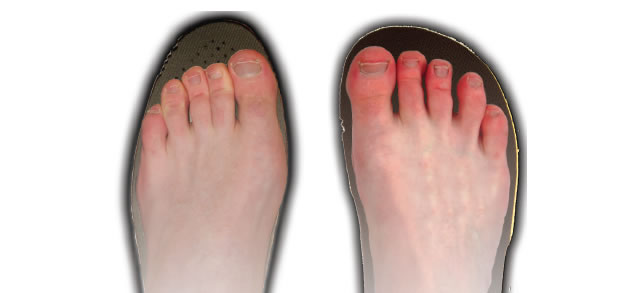
On the left is the way most shoe companies do it. The toes are cramped together and rounded in. On the right is Altra's shoe last. Which looks healthier for your feet? Do you see how crazy the whole thing is?
So this page is dedicated to promoting any shoe that meets my criteria of a descent running shoe:
1. It must be shaped like a human foot (no, it doesn't have to have separate toes like the FiveFingers)
2. It must be able to flex under the ball of the foot
3. It must not have a big heel, ultimately I'm hoping to not need any heel at all
4. It must keep the foot relatively close to the ground
I long ago could see how unproductive leaping forward could be in my running, so I've always tried to land over my foot. What they call a midfoot landing. As I've begun to understand how useful it would be to land on the ball of the foot (both for softening contact and for coiling the spring that pushes off moments later) I'vebegun working toward that goal. But I'm being very cautious, and I'm still not to the point where I can handle long runs like this. Thus I have two type of shoes I wear. For long runs I wear a pair with a modest heel and land flatfooted. But when I want to practice landing on the balls of my feet, any heel at all makes that difficult. When I'm wearing a shoe with a raised heel, the heel makes contact with the ground at the same time as the ball of my foot, even when I'm trying to get the front of the foot down first. If the heel weren't there, the ball of my foot would be landing first. You have to move to a completely flat sole if you want to take the next step and land toward your toes. So I'm going to mention the shoes with modest heels. Until we grow up running barefoot, they may have a place in the world. But I also want to applaud the companies creating shoes shaped like the human foot and eliminating the heel.
The Almost Minimalist Shoes

The Nike Free 2 is a shoe I happen to wear and like in part because it helped lead the revolution. I wish the Free gave the toes a little more room (though the "2" version did add a wee bit more room for the toes), and it does have a slightly raised heel, but it's better in most other ways than most of the shoes out there. I'm especially fond of how flexible it is in the forefoot. The foot is allowed to bend at the toes which gives the foot a better, more natural, workout. That is, it allows the muscles to function normally rather than being encased in rubber and not allowed to move much. Even if you want to try "barefoot running," I would recommend the Nike Free as a transition shoe. You don't want to switch over to barefoot running overnight. That's almost guaranteed to result in injury. This is the shoe I use when I'm running with a midfoot landing. When I want to practice running barefoot I switch to my Altras.
New Balance has it's version of a minimal shoe out now called the Minimus. I tried one on and was disappointed. It's similar to the Nike Free. Not quite shaped like the human foot but not as bad as some. Modest heel. Adequate cushioning, but not a lot. I liked the flexibility of it. But it has this strange feeling of pushing up against the outside edge of the foot. The store clerk laughed when I mentioned this and said that was her experience as well. I've bought a lot of New Balance shoes over the years, so I take no pleasure in my disappointment.
Thin-Soled
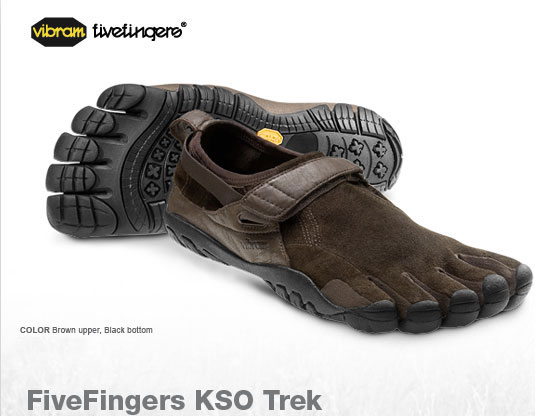
The Vibram FiveFingers gets special mention for having the nerve to look like a human foot. Bravo! (If you see a shoe on this page and get interested, click the picture and you'll be taken to the shoe company's web site.) Warning, it is not all goodness and light with the FiveFingers. I've got a pair of the Bikilas and I've never been able to put them on in less than 5 minutes. It's not that easy getting the toes into position. I'm not convinced this is the perfect solution. But I still admire the concept.
I found the array of shoe options confusing with the FiveFingers, so I thought I'd share what I think I've learned. They tend to create a shoe and then try and imagine all the ways you could use it. So a number of their shoes are designated as "running" shoes. Here's what little I've been able to figure out about why they were designated as running shoes:
Bikila: A shoe specifically designed for running and the model most likely to encourage making contact with your forefoot first. Ideal for sockless running in the summer. Sole thickness is 7 mm. There's very little cushioning involved. Despite my desire for a flat sole, I'd like a shade more cushioning. But I have special issues with my feet and this might be heaven for you.
Flow: Winter Running, warmer top layer and the black sole has slip resistance.
KSO Trek: Trail running, it has a layer within the sole to protect against stone bruises. Seems to me it would work for winter running as well. The sole thickness add up to 8 mm.
KSO: 5.5 mm sole. What they describe as their most versatile and popular shoe.
Sprint: 3.5 mm sole. As close to barefoot as you can get.
If you want socks for these shoes, check out Injinji. Regardless of whether you want to go the route of the Vibram shoes, I rather like the socks.

A company new to running shoes but attempting to get it right is Merrel. They've partnered with Vibram on a series of shoes they call the Barefoot (Vibram provides the sole). The Trail Glove version is shown to the right. I've just bought a pair. Like the FiveFingers the soles are incredibly thin. Unlike the FiveFingers if I decide I can't live without a little extra cushioning, I could insert an insole. They certainly make it easy to run on the balls of your feet. Time will tell. Here's their technical specs:
UPPER/LINING
* Merrell Omni-Fit(tm) lacing system secured with welded TPU provides a precise, glove-like fit
* Fused rubber toe bumper provides ultimate durability
* Synthetic leather rear foot sling provides stability
* Flexible plate in the forefoot protects the foot from stone bruises
* Non-removable microfiber footbed treated with Aegis(r) antimicrobial solution resists odor
MIDSOLE/OUTSOLE
* 4mm compression molded EVA midsole cushions
* 1mm forefoot shock absorption plate maintains forefoot flexibility and protects the foot by distributing pressure
* Vibram(r) Trail Glove Sole/ Rubber Compound TC-1
* Men's Weight: 6.2 ozs / 175.8 gm (1/2 pair)
It would appear they've done everything right. But keep in mind, neither the Five Fingers nor that Merrel has an cushioning. If you're running on grass, you may not feel you need any. But I really feel it
The Final Solution
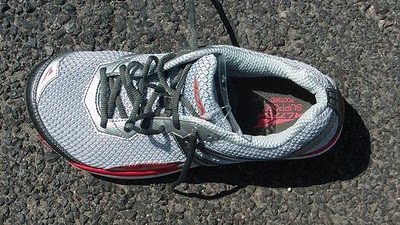
The Altra company is also brand new to the world of running shoes. As far as I'm concerned they're the future of running shoes. They have models with little cushioning and others with cushioning. I've got the model with cushioning and I'm in love. All their shoes are zero drop. In other words, they have no heel. If you want to do barefoot running, that's essential. I love the fact that the Altra is shaped like a human foot. They don't deform my toes. In fact there's nothing I don't like about these shoes. They aren't widely available in stores yet. But you can buy them through their web site. They're doing everything right. My one word of caution is to purchase a pair a half size larger than normal. I find they run a little smaller than most. Here's a shot of the bottom of their shoe:

The Warning
I believe that learning how to run by landing on the ball of your foot is the way to go. We're going to call this barefoot running regardless of whether you wear shoes or not. So after running for 40 years one way, I'm trying to learn a new way to run. (There's more on this on the running page.) But understand this. You're shifting stress away from your knees and onto the foot and Achilles tendon. You'll also feel it in your calf. If you decide to make the change, it must be gradual. It's been months now, and I'm still limiting myself to under two miles a day running in barefoot mode. If you're not an old man like me, you might be able to shift quicker. But please be careful. Many have injured themselves in the effort to find a safer more injury-free running style. This is called irony. Take your time.
More shoes will be added to the page as more companies find their way into the light.
Multiple Shoes
One last idea, shoes wear out. If you're running 50 miles a week, you're going to need a new pair of shoes at least every few months. If you're only doing 25 miles a week, maybe they'll last half a year. But why not just go ahead and get a couple of pairs and alternate wearing them. You'll still need to replace them eventually, but they'll last twice as long. I have pain in my feet so I'm always looking for a pain-free shoe and will buy a new pair of shoes even when I've got half a dozen at home. But that means I don't wear the same shoe two days in a row and the unique stress from running in a particular pair shoes is not repeated day in and day out. There are new stresses with each pair, but they're different and don't accumulate. It also means that I have favorites. I've had extensive experience with each shoe and I know which one will be best for a given day. As I write this I've got a marathon in a couple of days. I know exactly which shoe I want to wear, and I'll be a little better off as a result.
Shoe Modifications
I've also taken to fixing shoes. If I've got a shoe that's pressing my big toe inward, I'll take my trusty Exacto knife and carve a little flap alongside the big toe. It doesn't seem to do any serious damage to the shoe and it gives my toes a little more room.